
GEO Optimization for AI Search: Why Being Good Isn’t Enough Anymore
You’ve written solid content. Your site is technically clean. You rank on the first page of Google for your core keywords. And yet, when a potential customer asks ChatGPT or Perplexity to recommend the best digital marketing agency in Bangladesh, your name doesn’t come up.
Someone else does.
That’s the new gap in digital marketing, and it’s widening fast. AI search engines don’t just reward visibility; they make active, algorithmic decisions about whose knowledge is worth citing. Understanding what drives those decisions is no longer a nice-to-have. It’s where competitive advantage lives right now.
If you’ve already read our introduction to Generative Engine Optimization on the Implevista Digital blog, you know the “what.” This article goes several layers deeper: the specific, measurable ranking factors that AI engines use when deciding which sources to recommend and what you can actually do to influence each one.
How AI Engines Actually Score Content Before Recommending It
Before diving into individual factors, it helps to understand the scoring process. Traditional search engines rank pages in a list. Generative AI engines do something more complex: they retrieve multiple content passages, evaluate them against several quality dimensions simultaneously, and synthesize a response that blends the highest-scoring inputs.
That means a page isn’t just ranked. It’s evaluated and weighted in real time. Two articles on the same topic can both be retrieved. Still, the one that scores higher on authoritativeness, directness, and structural clarity will contribute more to the final answer and receive the citation.
The research paper that defined GEO as a discipline (published by Princeton, Georgia Tech, and IIT Delhi) found that simple keyword optimization actually hurts AI visibility in some cases. But adding original statistics, clear citations, and authoritative sourcing improved impression scores by up to 37% over the baseline.
That’s the mindset shift: GEO optimization for AI search is not about gaming the algorithm. It’s about making your content genuinely and demonstrably more trustworthy than your competitors’. Every decision you make around GEO optimization for AI search should start from that principle.
Factor 1: Answer Precision
Why are the first 150 words the most important in real estate
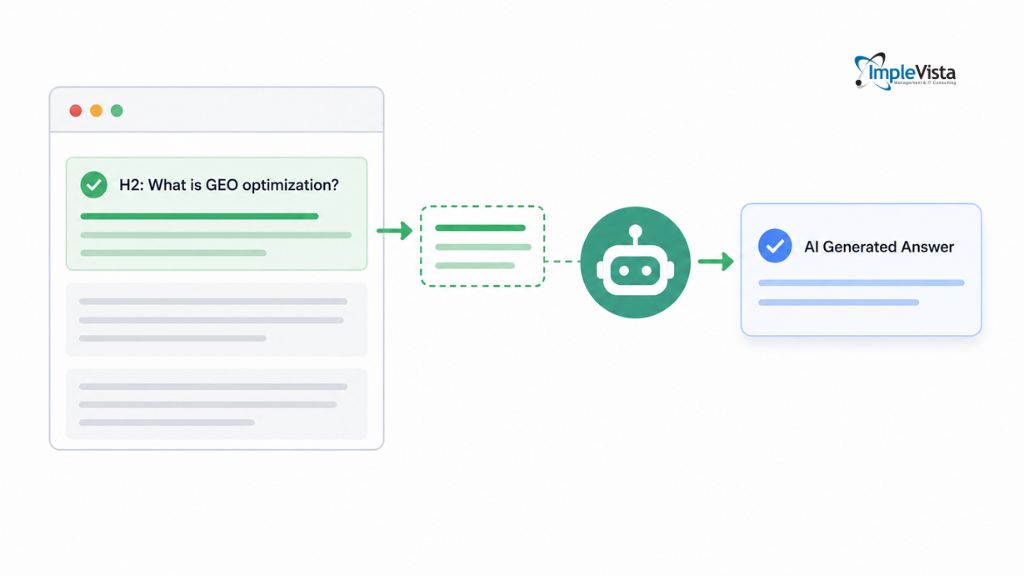
AI retrieval systems, particularly those using Retrieval-Augmented Generation (RAG), extract specific passages from your content rather than reading the whole page. Those passages are then fed into the language model as context for generating the answer.
The practical implication: your content needs to contain dense, precise, directly answerable passages that map cleanly to a specific question. Not eventually. Not in paragraph four. In the first scroll.
Content structured as long, winding introductions that “build toward” the point doesn’t get extracted. Content that leads with a clear, precise answer does.
What “answer precision” looks like in practice:
- Lead every major section with its conclusion first
- Use the question itself as the heading (H2 or H3), then answer it in the opening line beneath it.
- Avoid filler phrases like “In today’s fast-paced world…” These are extraction dead zones
- Keep your most citable sentences self-contained: they should make complete sense even without the surrounding context
Think of each heading-and-paragraph pair as a potential AI snippet. If you cut out that paragraph and showed it to someone cold, would it answer a real question? If not, rewrite until it does.
This is one of the clearest differences between content written for traditional SEO and content written for GEO optimization for AI search. Traditional SEO rewards keyword presence and word count. GEO rewards the density of useful answers per page
Factor 2: Sourced Credibility
This one surprises many marketers: the citations inside your content directly affect how AI systems perceive the credibility of your content as a whole.
When an AI model retrieves a passage and sees that it’s backed by a named study, a verifiable statistic, or a reference to a recognized authority, it treats that passage as higher-confidence information. Unsourced claims, even accurate ones, contribute to responses with lower confidence scores.
The GEO research paper specifically found that “statistics addition” and “quotation addition” (attributing statements to named sources) were among the highest-performing GEO tactics, improving AI visibility by measurable margins over content without those elements.
How to build sourced credibility:
- Replace vague claims with specific, sourced statistics. “Most businesses have adopted AI tools” becomes “According to a 2025 Forrester report, 89% of B2B buyers now use generative AI as a primary research source.”
- Cite academic research, government data, and recognized industry publications within your body copy
- Name your sources explicitly rather than burying them in a reference list
- Publish original data, proprietary surveys, client case studies, and platform-specific benchmarks, since original research is the most citable content type that exists
At Implevista Digital, this is one of the first structural changes we make when auditing content for GEO optimization for AI search readiness: scanning for unsourced assertions and replacing them with evidence-based claims.
Factor 3: Entity Recognition
AI language models don’t just read text; they recognize entities: specific people, companies, products, locations, and concepts that have been consistently described across multiple sources. When your brand is recognized as an entity rather than just a string of characters, AI systems are dramatically more likely to recommend it in responses.
Entity recognition is driven by how consistently and accurately your brand is described across the web. This includes:
- Your Google Business Profile (name, category, description, reviews)
- Wikipedia pages or structured knowledge base entries
- Wikidata or schema.org markup on your own site
- Consistent Name/Address/Phone (NAP) data across directories
- How media, publications, and other sites describe your brand
If ten different websites describe your business inconsistently, with different names, different service descriptions, and different locations, AI systems have a fuzzy, low-confidence picture of your entity. If they all say the same thing, that signal is strong and unambiguous.
Building entity recognition:
- Claim and fully complete your Google Business Profile with precise category tagging
- Implement the Organization schema on your homepage with a consistent name, logo, URL, and contact information
- Audit third-party directory listings for NAP consistency
- Earn brand mentions in authoritative publications; even a short mention in a credible article contributes to entity strength
- Consider a Wikidata entry if your organization is significant enough to merit one
For businesses with regional reach like Implevista, entity recognition in Bangladesh-specific queries requires a consistent presence across local business directories, industry associations, and regional media. This is local GEO optimization for AI search, and it’s highly actionable.

Factor 4: Topical Depth
Here’s a factor that’s easy to misunderstand. “Topical depth” doesn’t mean writing longer articles. It means that your website as a whole covers a topic comprehensively enough that AI systems recognize you as a domain authority on that subject.
When an AI retrieves content for a query, it’s not choosing between individual articles in a vacuum. It has a broader sense of how much a website “owns” a topic. A site with one good article on GEO optimization for AI search will lose to a site that has ten interlinked, high-quality pieces covering related angles, from GEO ranking factors to measuring GEO performance to GEO for specific industries.
This is why topic cluster architecture matters so much for GEO. Not just because it helps with traditional SEO (though it does), but because the cluster structure signals to AI systems that you’re the most comprehensive source on a subject, not just a one-hit contributor.
Building topical depth:
- Map every sub-question in your topic space and assign it a content piece
- Interlink pieces explicitly (a ranking factors article should link to a measurement guide, which links to a platform-specific guide, etc.)
- Cover adjacent questions, even when they’re not your primary keyword targets; they build the perimeter of your topical authority
- Use consistent terminology across your content cluster so AI systems can easily associate pieces with the same topic
You can see this principle applied across Implevista Digital’s blog, which has built out a progressively deeper content ecosystem around SEO and digital marketing topics. The accumulation of that content creates a compounding GEO advantage over time.
Factor 5: Content Freshness
AI systems, especially those that use real-time web retrieval, place significant weight on content freshness. Research consistently shows that AI-cited content tends to be substantially more recent than content ranked in traditional search results.
There’s a practical reason for this: AI systems are built to synthesize accurate, current information. For any query involving recent developments, current best practices, or evolving technology (like AI search itself), a three-year-old article is a liability, not an asset.
What’s less obvious is the scope of freshness signals. It’s not just the publication date. AI crawlers pick up:
- The “Last Updated” date displayed on the page
- The dates of statistics and data references within the content
- The recency of external links cited in the article
- Whether the article references events or tools from the current year
Freshness optimization tactics:
- Display a visible “Last Updated” date on every important content page
- Conduct a quarterly audit of statistics; replace any data older than 18 months with current figures
- Add a “What’s Changed in [Current Year]” section to your most important evergreen articles
- Update your external link references to the most recent version of cited sources
- Refresh at least one structural element (new section, updated table, revised examples) during each update
This doesn’t require rewriting everything. A focused 30-minute refresh of an existing article, updating five statistics, adding a current example, and revising the date, can meaningfully improve its AI retrieval performance.
The Implevista Digital team builds content refresh cycles into every ongoing retainer specifically because we’ve seen the impact of freshness on GEO optimization for AI search visibility. It’s one of the lowest-effort, highest-return GEO optimizations available.
Factor 6: Structural Parsability
AI retrieval systems are not human readers. They parse content programmatically, and certain structural patterns make content dramatically easier, or harder, to extract usefully.
This is where many technically competent websites quietly fail at GEO optimization for AI search. The content may be excellent, but if it’s buried inside JavaScript-rendered components, hidden behind tabs, or structured without semantic HTML, AI crawlers either can’t reach it or can’t parse it accurately.
The GEO-Friendly Content Structure
Headings that mirror real user queries are the single most impactful structural element for GEO. A heading that reads “How Do AI Engines Select Sources for Their Answers?” is far more likely to be retrieved for that specific query than a heading that reads “Our Methodology.”
Here’s the structural checklist that separates GEO-ready content from content that AI systems skip:
HTML and technical structure:
- Use proper semantic HTML<h3> tags with meaningful hierarchy
- Ensure critical content is server-side rendered, not loaded via JavaScript after page load
- Keep key passages in standard <p> tags rather than custom components
- Implement FAQ schema (FAQPage) around any Q&A content, as AI systems disproportionately extract FAQ content
Content formatting:
- Format H2 and H3 headings as natural language questions where possible
- Place the direct answer to each section’s heading in the first 1–2 sentences under it
- Use bulleted or numbered lists for multi-part answers; they’re a high-extraction format
- Include a TL;DR or summary box at the top of long articles
- Keep paragraphs under 4 sentences in body content sections
Schema markup priorities for GEO:
- FAQ Page: the highest extraction rate for AI content
- Article / BlogPosting, standard editorial signal
- HowTo, effective for instructional content
- Organization, entity verification signal
- LocalBusiness, critical for local AI recommendations
The connection between schema and GEO performance is well documented: pages with properly implemented structured data show markedly higher inclusion rates in AI-generated answers than equivalent unstructured pages.
Factor 7: Citation Footprint
This is the factor most SEO teams discover last, and it’s often where the biggest competitive gaps in GEO optimization for AI search exist. AI systems don’t evaluate your content in isolation. They weigh it against how your brand is discussed across the entire web.
A page on your site that’s technically excellent but exists in a citation vacuum, with no external sites referencing your research, no community discussions mentioning your brand, and no reviews on third-party platforms, will underperform against a page from a competitor who has built a genuine third-party presence.
This is because AI models learn from patterns of co-citation and endorsement across the web. A brand mentioned positively in ten independent sources carries more weight than a brand that only mentions itself.
Building Your Citation Footprint
- Earned media and PR: A single feature in a credible industry publication, even a short mention of your company alongside a relevant statistic, contributes to your citation footprint. The goal isn’t volume. Its presence in the sources AI systems trust.
- Community participation: Reddit, LinkedIn, Quora, and industry-specific forums now appear regularly in AI-cited content. Authentic participation in these communities, answering questions, contributing insights, and building a reputation translate directly into GEO equity.
- Third-party review platforms: G2, Capterra, Google Reviews, and Trustpilot are actively retrieved by AI systems when generating brand recommendations. A business with 50 consistent, positive reviews on these platforms carries a citation authority signal that a company with no external reviews simply cannot match.
- Original publishable research: This is the highest-leverage citation-building activity available. When you publish a benchmark study, an industry survey, or a data-driven analysis that other content creators and journalists reference, every one of those references strengthens your AI citation footprint. One well-promoted original research piece can generate more GEO equity than a year of standard blog posts.
For software products within the Implevista ecosystem, like IV Trip, Bangladesh’s travel agency management platform, this means systematically building a presence on travel software review platforms, earning media coverage in travel industry publications, and generating case study content that third parties can reference.

FAQs: GEO optimization for AI search
Q1. What are the most important ranking factors for GEO optimization for AI search?
The seven core factors for GEO optimization for AI search are answer precision (direct, extractable content); sourced credibility (cited statistics within your content); entity recognition (consistent brand identity across the web); topical depth (comprehensive topic cluster coverage); content freshness; structural parsability (semantic HTML and schema markup); and cross-platform citation footprint. All seven work together; strength in one area rarely compensates for weakness in another.
Q2. How does GEO optimization for AI search differ from traditional on-page SEO?
Traditional on-page SEO optimizes for keyword presence, meta fields, and ranking signals Google uses to position pages in results. GEO optimization for AI search targets the quality signals that AI retrieval systems use to select passages to include in a synthesized answer. GEO requires more emphasis on answer precision, in-content sourcing, schema markup, and cross-platform brand presence than traditional SEO does.
Q3. Why do AI systems sometimes cite lower-ranking pages over top Google results?
AI retrieval systems evaluate content quality signals that don’t map 1:1 with Google rankings. A page with highly specific, well-sourced, directly answerable content may be retrieved and cited even if it ranks on page 2 of Google, while a vague page-1 result may be skipped. This is a genuine GEO optimization for an AI search opportunity; structured, authoritative content can earn AI citations regardless of traditional ranking position.
Q4. How do I know if AI engines like ChatGPT are citing my content?
The most reliable method is manual testing: run 10–15 relevant queries monthly in ChatGPT, Perplexity, and Google Gemini, and document whether your content or brand appears. Tools like Profound, Brandwatch, and emerging AI visibility platforms also offer automated monitoring. Track AI referral traffic in Google Analytics 4 as a secondary signal.
Q5. Does schema markup really affect whether AI recommends my content?
Yes, significantly. Pages with properly implemented schema markup, especially FAQPage, Article, and HowTo, show substantially higher inclusion rates in AI-generated answers. Schema helps AI crawlers understand exactly what your content is about, improving the accuracy of retrieval for relevant queries.
Q6. How important is original research for GEO optimization for AI search?
Extremely important. Original data, proprietary surveys, platform benchmark studies, and client case studies with real metrics are the most citable content types in GEO. AI systems strongly favor specific, attributable statistics over general claims. A single well-promoted original research piece can build more citation authority than a dozen standard articles.
Q7. How often should I update content to maintain GEO visibility?
At a minimum, review your top pages quarterly. For fast-moving topics like AI search, technology, or digital marketing, monthly refresh cycles are more appropriate. The key signals to update are statistics (replace anything older than 12–18 months), examples (add current-year references), and the visible “Last Updated” date. Content freshness is a measurable, improvable factor.
Q8. What’s the relationship between geo and SEO in a modern digital strategy?
They are complementary, not competing. Strong traditional SEO, crawlability, quality content, and authoritative backlinks provide the foundation that GEO builds on. AI systems using real-time retrieval pull from the same pages Google indexes, so SEO performance directly feeds GEO visibility. The integrated approach is to optimize for both simultaneously rather than treating them as separate projects.
Q9. Can small businesses in Bangladesh compete with larger brands in GEO?
Yes, and in some ways more easily than in traditional SEO. GEO rewards content quality and specificity over domain authority alone. A small business that publishes genuinely useful, well-sourced, structurally optimized content on a niche topic can earn AI citations in that space regardless of overall domain size. Hyper-specific, locally relevant content, such as “best travel agency software for Bangladesh agencies” or “digital marketing for e-commerce in Dhaka,” is a particularly effective GEO entry point.
Q10. How long does it take to see GEO results after optimizing content?
GEO results can appear faster than traditional SEO rankings. For pages that AI systems can immediately crawl and retrieve, meaningful improvements in citation frequency can show up within 4–8 weeks of implementing answer precision, schema, and freshness optimizations. Building a citation footprint (Factor 7) is a longer game: 3–6 months of consistent effort. Full topical authority development typically takes 6–12 months of sustained content cluster building.
Conclusion: GEO Is a Precision Discipline, Not a Trend to Watch
The brands that win in AI search aren’t necessarily the ones with the biggest budgets or the most content. They’re the ones who understand the scoring system and build for it deliberately.
GEO optimization for AI search rewards the same things that have always made content genuinely useful: clear answers, credible sourcing, consistent expertise, and authentic authority. The difference is that now, AI systems are evaluating those qualities algorithmically, in real time, and making citation decisions that increasingly shape what your potential customers learn and who they trust.
The seven factors covered in this article, answer precision, sourced credibility, entity recognition, topical depth, content freshness, structural parsability, and citation footprint, are your levers. Every one of them is measurable. Every one of them is improvable. And unlike a Google algorithm update you can’t predict, these are factors you can work on right now.
At Implevista Digital, we build GEO and SEO strategies together because in 2026, you can’t afford to separate them. From content marketing and structured data implementation to full GEO audits and citation-building campaigns, our team is ready to help your brand become the source that AI engines recommend.
Is Your Brand Invisible to AI Search Right Now?
Run your own quick test: ask ChatGPT or Perplexity the question your best customers would use to find a business like yours. If your brand doesn’t appear, you have a GEO gap, and it’s costing you real opportunities.
Start a Conversation with Implevista Digital →
Or explore how our SEO and content marketing services are built to earn AI visibility, not just Google rankings.
Want articles like this delivered to you first? Subscribe to the Implevista Digital blog for the latest on GEO, SEO, and digital marketing strategy.