Introduction: The Search Landscape Has Changed Forever
Search behavior has changed significantly in recent years. Instead of scrolling through multiple search results, users now often rely on AI-generated answers that appear at the top of search platforms. This shift has major implications for how businesses are discovered online and how visibility is achieved in a digital-first environment.
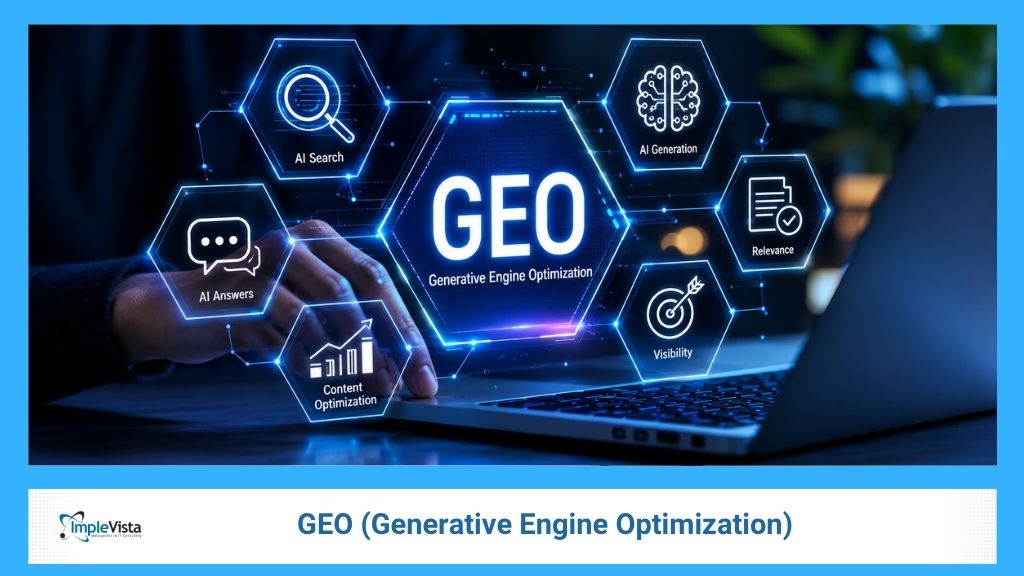
This is where GEO (Generative Engine Optimization) comes in. It represents the next stage of search optimization, where AI-powered systems like ChatGPT, Google AI Overviews, Perplexity AI, and Microsoft Copilot determine which sources to trust, cite, and surface in responses. In this guide, we explore what GEO is, how it differs from SEO, and why businesses must adopt it to remain visible and competitive in AI-driven search.
Key Statistic
AI-referred sessions jumped 527% year-over-year in the first five months of 2025 (Previsible, 2025 AI Traffic Report). ChatGPT crossed 900 million weekly active users by February 2026. 58% of Google searches now end in zero clicks. The shift is not coming — it is here.
The Growing Importance of Generative Engine Optimization
Search is evolving beyond a list of website links. AI-powered search experiences now help users explore complex questions, compare information, and discover relevant sources through generated responses, at a scale that’s grown faster than almost any Search feature Google has shipped.
Google reported in June 2026 that AI Overviews had surpassed 2.5 billion monthly active users, while AI Mode, its conversational search experience, had crossed 1 billion monthly users roughly a year after launch. These figures describe reach within Google Search specifically; they aren’t estimates of unique users across every AI platform combined.
For businesses, this represents a genuine opportunity to reach customers through AI-powered discovery. But appearing in an AI-generated response isn’t guaranteed, even for a site that performs well in traditional search. The practical takeaway is to keep investing in useful content, strong technical SEO, clear site architecture, and credible sourcing, while monitoring how that content actually performs across these newer search experiences.
1. GEO (Generative Engine Optimization): Definition and Core Concepts
1.1 The GEO (Generative Engine Optimization) Definition
GEO (Generative Engine Optimization) is the practice of structuring, formatting, and positioning your content so that AI-powered generative engines — such as Google AI Overviews, ChatGPT, Perplexity AI, and Microsoft Copilot — select your brand as a trusted source when constructing their responses to user queries.
Unlike traditional SEO, which aims to earn a click by appearing high in a search results list, GEO aims to earn a citation within an AI-generated answer. The fundamental goal shifts from “rank high” to “be quoted.” And in a world where 58% of searches end without a single click (SparkToro, 2026), being quoted is often the only form of visibility available.
The term was first popularised in academic and marketing circles around 2023–2024 and has since grown in relevance. Google’s own position, laid out in guidance it published in May 2026 on optimizing for generative AI features in Search, is more measured than “GEO is a separate discipline”: it states that AI Overviews and AI Mode run on Google’s existing ranking and quality systems, and that there’s no special schema, file, or technique that substitutes for the same fundamentals that support traditional SEO. In other words, Google frames this as an extension of SEO rather than confirmation of a wholly new algorithm to game.
1.2 How Generative Engines Work (and Why They Are Different)
To understand GEO, you first need to understand what makes generative engines different from the search engines we grew up with.
Traditional search engines (Google, Bing) crawl the web, index pages, and rank them by hundreds of signals, including keywords, backlinks, page speed, and domain authority. They present a list of links. The user decides what to click.
Generative engines do something fundamentally different:
- They retrieve: The AI searches for relevant sources, often in real-time.
- They reason: The AI synthesises information across multiple sources.
- They generate: The AI writes a natural-language answer citing the most trustworthy sources.
- They present: The user reads a polished, conversational answer — often without visiting any website.
Generative engines parse meaning, not keywords. They prefer content structured around clearly defined entities, explicit claims, verifiable statistics, FAQ formats, structured data (schema.org markup), and well-organised headings. The goal, as one research guide puts it, is not “to be ranked” but “to be quotable.”
2. GEO vs SEO: Understanding the Key Differences
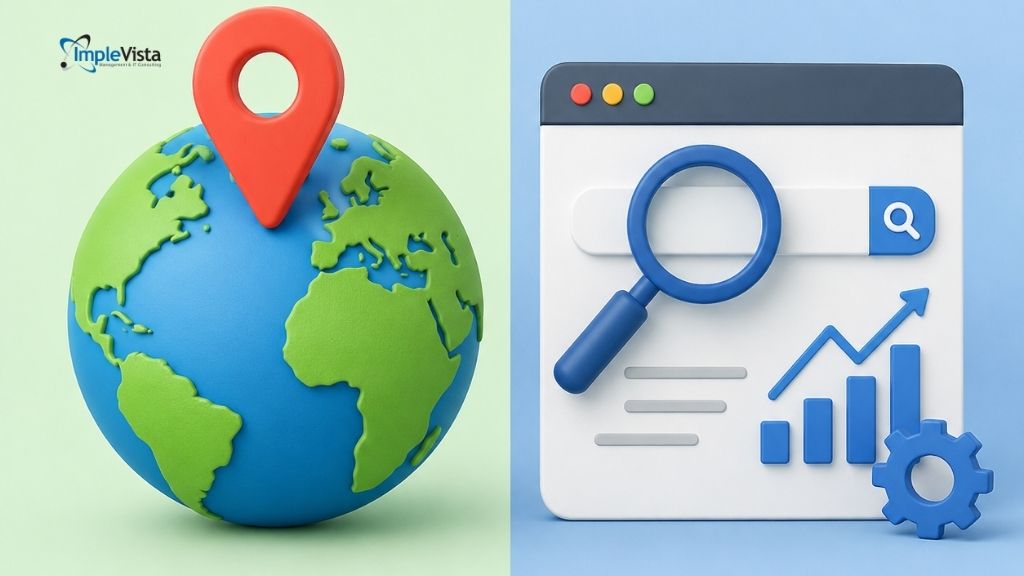
One of the most common questions we hear from clients at Implevista Digital is: “Should I focus on GEO or SEO?” The honest answer is both, but understanding the differences is essential to knowing how to invest your efforts.
| Dimension | Traditional SEO | GEO (Generative Engine Optimization) |
| Primary Goal | Earn a high ranking in SERP | Earn a citation inside an AI-generated answer |
| Success Metric | Click-through rate, page ranking | Brand mentions in AI responses, citation frequency |
| Content Focus | Keyword density, backlinks, and meta tags | Factual density, structured data, entity clarity |
| User Journey | A user clicks through to your site | User absorbs your brand message directly in the AI response |
| Conversion Path | Longer (index → click → read → convert) | Shorter (users arrive pre-informed, closer to decision) |
| Key Platforms | Google, Bing, Yahoo | ChatGPT, Gemini, Perplexity AI, Google AI Overviews |
GEO is not a replacement for SEO — it is an evolution. Think of SEO as getting your content indexed, and GEO (Generative Engine Optimization) as getting your content interpreted, trusted, and cited. Both matters. A strong SEO foundation (technical health, quality backlinks, domain authority) actually makes your SEO efforts more effective, because AI engines favour sources that are already considered authoritative by the wider web.
However, there is a meaningful practical difference worth watching: a user arriving via a GEO citation has typically already read an AI-synthesised answer that featured your brand, which can put them further along in their decision-making than a typical organic click. Treat this as a reason to monitor referral traffic and conversion rate from AI sources specifically, rather than assuming a conversion lift before you’ve measured it on your own traffic.
For businesses operating in Bangladesh and across South Asia — markets where mobile-first users increasingly rely on voice search and AI assistants — GEO (Generative Engine Optimization) is not a future consideration. It is a present-day necessity. Implevista Digital, as the leading digital marketing agency in Bangladesh, is already helping clients build GEO strategies tailored to this rapidly evolving landscape.
Businesses looking to improve visibility across both traditional and AI-powered search should start with a strong digital marketing strategy: useful content, an accessible website, solid internal linking, and information that’s easy to find. For a broader look at building that foundation, see our digital marketing agency guide.
3. Why Businesses Need GEO Right Now: The Data Behind the Urgency
Some trends are gradual. The shift to AI-powered search is not. Consider the following data points — all from 2025–2026:
- Google AI Overviews now appear in approximately 25% of all Google searches (up from 13% in early 2025), with health and education queries triggering them over 60% of the time (Conductor, 2026 analysis of 21.9 million queries).
- Zero-click searches now account for 58% of all Google searches, meaning the majority of users never visit a website at all (SparkToro, 2026).
- ChatGPT processes 2.5 billion prompts per day (mid-2025 data) and has crossed 900 million weekly active users.
- 58% of consumers have already replaced traditional search engines with AI tools for product and service discovery (Capgemini, 2025).
- 64% of customers express readiness to purchase products suggested by AI (Master of Code, 2024).
- Gartner predicts a 30% drop in traditional search volume by the end of 2026 as generative engines continue to dominate.
- Brands cited in AI Overviews earn approximately 120% more organic clicks per impression than uncited brands on the same queries (Seer Interactive, 2026).
These are not projections. They are current realities. And they mean one thing for businesses: if you are not appearing in AI-generated answers, a growing majority of your potential customers simply do not encounter your brand during their decision-making process.
💡 The Business Case in One Sentence
GEO (Generative Engine Optimization) is the bridge between the content you create and the AI answers your customers are already reading — without clicking a single link.
4. How GEO (Generative Engine Optimization) Works: Core Strategies
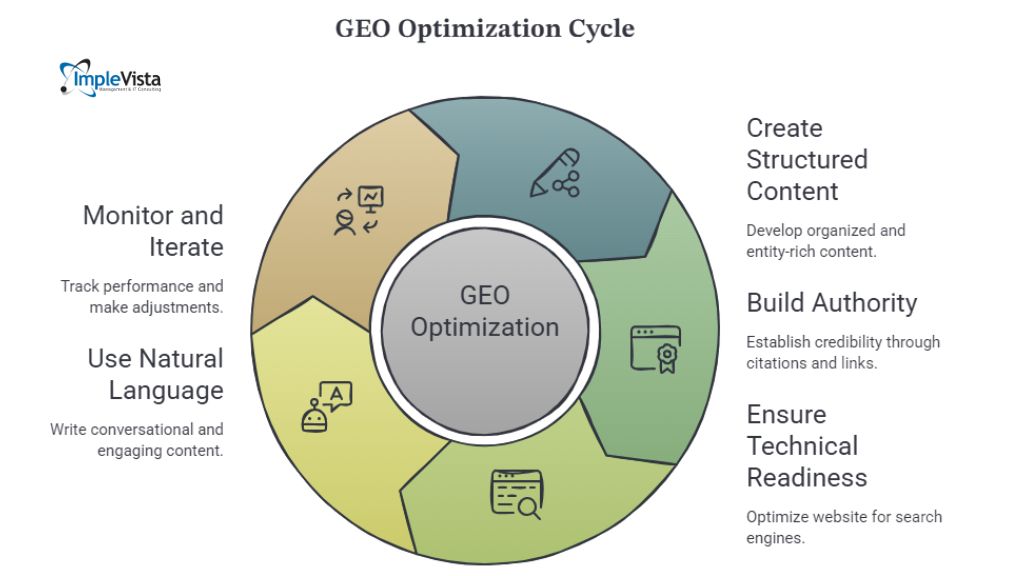
4.1 Structured, Entity-Rich Content
Generative engines do not just read words — they map entities, relationships, and claims. Every important page on your website should clearly define what your business is, what problems it solves, who it serves, and what results it delivers.
Vague authority claims like “we are a market leader” provide nothing extractable for an AI. Specific, verifiable statements — “our 2025 benchmark across 50+ client campaigns showed a 38% average increase in organic leads within six months” — give generative engines exactly the kind of quotable, trustworthy content they prefer.
- Use clear entity definitions in opening paragraphs (what is this? who is it for?).
- Include structured FAQ sections, how-to formats, comparison tables, and numbered lists.
- Implement schema.org markup (FAQPage, HowTo, Article, Organization, Product).
- Cite sources explicitly — hyperlink to authoritative institutions, government data, and research papers.
- Include expert quotes — internal expertise and external authority signals both matter.
4.2 Authority and Citation Building
Large language models are trained on the open web, and many also retrieve from it in real time. This means your brand’s visibility in third-party content — industry publications, community forums, Q&A platforms, podcasts, social media — directly influences whether AI engines trust and cite you.
Strategies include:
- Digital PR: Get your brand mentioned in authoritative news outlets, trade publications, and industry reports.
- Forum Participation: Engage meaningfully on Reddit, Quora, and niche community platforms — AI tools like ChatGPT and Perplexity heavily cite these sources.
- Wikipedia Presence: Where applicable, ensure your brand or key concepts you own have accurate Wikipedia entries.
- Review Platforms: Encourage verified customer reviews on Google, Trustpilot, and industry-specific platforms.
4.3 Technical GEO Readiness
Technical SEO and technical GEO (Generative Engine Optimization) share significant overlap, but GEO adds specific requirements:
- AI-friendly formatting: Clear H2/H3 headings, summary boxes, tables, and bulleted lists help AI engines extract and structure your content.
- Fast load times and mobile-first design: Generative engines favour sources that perform well technically — slow, broken pages are skipped.
- Schema markup: Structured data (JSON-LD) helps AI engines understand your content type, author expertise, and publication date.
- robots.txt and llms.txt: Emerging standard “llms.txt” files allow site owners to guide AI crawlers, similar to how robots.txt guides search engine bots.
- Core Web Vitals: Google’s performance metrics remain important because AI Overviews are still part of Google Search.
Technical SEO and technical GEO overlap heavily—if you have a dedicated technical SEO service page, add one sentence and link here, e.g., “If your site has known crawlability or speed issues, our technical SEO services team addresses these as the first step in any GEO engagement.” (Using your SEO agency page as the closest existing match—swap in a dedicated technical SEO URL if you have one.)
4.4 Natural Language and Conversational Content
AI engines process queries in natural language — “what is the best accounting software for small businesses in Bangladesh?” not “accounting software Bangladesh.” Your content needs to reflect this reality.
- Write in a conversational, question-answering format.
- Anticipate the exact phrases users type into AI chatbots and address them directly.
- Keep sentences clear and direct — AI engines prefer prose that can be extracted and quoted verbatim without losing meaning.
- Vary sentence length and structure to signal human-quality writing (AI engines have become adept at detecting thin, auto-generated content).
4.5 Monitoring and Iteration
Unlike SEO, where you track keyword rankings, GEO requires a new set of metrics:
- Brand mention tracking in LLM responses: Tools like Brandwatch, Mention, and emerging GEO-specific platforms allow you to monitor how often your brand appears in AI-generated answers.
- Branded search trend analysis: Rising branded search volume often indicates growing AI-driven awareness.
- Pipeline and engagement metrics: Shift focus from raw traffic volume to lead quality, engagement depth, and conversion rate — GEO traffic often converts at higher rates even in smaller volumes.
- Citation frequency: Track how often your content is cited as a source in AI Overviews using Search Console data and third-party monitoring tools.
As of August 31, 2026, Google has fully rolled out dedicated Search Generative AI performance reports in Search Console worldwide, giving site owners impressions data specifically for AI Overviews, AI Mode, and generative AI features in Discover, broken down by page, country, and device (though not yet by click). Use this alongside your regular Search Console performance data rather than as a replacement for it.
For ChatGPT specifically, OpenAI confirms that referral links from ChatGPT Search carry a utm_source=chatgpt.com parameter, so identifiable ChatGPT referral traffic can be tracked in Google Analytics or any standard analytics platform. Combine that referral data with a recurring manual-testing routine: keep a fixed list of realistic customer queries and periodically check whether your brand appears, noting the platform, query, cited source, and date so results are comparable over time.
GEO Principles in Practice: Ice Maker Supply
Generative Engine Optimization builds on many of the same principles that support effective SEO: useful content, clear information architecture, and a technically accessible website.
A practical example is Implevista Digital’s work with Ice Maker Supply, a U.S.-focused, high-ticket e-commerce business specializing in commercial ice machines and related equipment. The project involved building a Shopify-based e-commerce platform with an SEO-friendly product and category structure, along with technical SEO, keyword research, collection-page optimization, internal linking, buying guides, FAQs, and informational content built around what commercial buyers actually need to know before purchasing.
Several elements of that project line up directly with GEO principles:
- Content relevance: Buying guides and FAQs address real questions commercial buyers ask when comparing equipment.
- Topical depth: Product categories and supporting content cover different commercial ice machine types and use cases.
- Structural clarity: Product architecture, navigation, metadata, and internal linking help both users and search systems understand how pages relate to each other.
- Technical accessibility: Technical SEO and search-friendly architecture give search engines a clean foundation to work from.
To be clear about what this does and doesn’t demonstrate: the project’s documented results are organic-search and e-commerce outcomes, not measured AI-citation results. It’s best read as a real example of the SEO and content practices that support AI-search readiness, not as a case study of measured GEO performance specifically. Read the full Ice Maker Supply case study for the complete breakdown.
5. The Future of SEO Is GEO: What Comes Next
The future of SEO is inextricably linked with generative AI. The two disciplines are converging into what some are calling “OmniSEO” — a unified approach to visibility across traditional search, social search (TikTok, YouTube), and generative AI search simultaneously.
Several emerging trends are shaping the next phase of GEO (Generative Engine Optimization) in digital marketing:
5.1 Agentic Search
AI-powered agents — like OpenAI’s Operator (launched January 2026) — go beyond answering questions. They browse the web, compare options, and complete tasks on behalf of users. When an AI agent is booking travel for a user, it might compare flight packages, read reviews, and make a booking — all without the user touching a keyboard. For businesses like travel agencies, this is both a threat and an opportunity.
Implevista’s own travel management product, IV Trip, is designed with exactly this kind of digital-first future in mind. Travel agencies using IV Trip benefit from a system built to integrate with modern discovery channels. Learn more at ivtrip.implevista.com.
5.2 Semantic Relevance Over Keyword Stuffing
By early 2026, GEO practitioners will have largely moved past simple keyword placement toward “semantic relevance” — ensuring that content clearly addresses the meaning, context, and intent behind a query, not just its surface-level words. This shift benefits businesses that invest in genuine expertise and depth over those that chase keyword density.
5.3 AI Monetisation and Paid GEO Visibility
Both OpenAI and Google have begun testing monetised placements within AI-generated responses. This is adjacent to organic GEO but points to a near future where paid and organic AI visibility will coexist — much as paid search and organic SEO do today. Businesses that build organic GEO (Generative Engine Optimization) authority now will be better positioned to complement it with paid AI visibility when that market matures.
5.4 E-Commerce and GEO
For e-commerce businesses, the implications of GEO are enormous. When a user asks an AI, “What is the best laptop under 50,000 taka?”, the AI does not show ten links — it makes a recommendation, citing specific products and stores. For Bangladeshi e-commerce brands, being the cited source in that answer is the new prime shelf position. Implevista’s e-commerce solutions are built to support this kind of structured, AI-readable product data.
6. What Is GEO in Digital Marketing? A Practical Framework
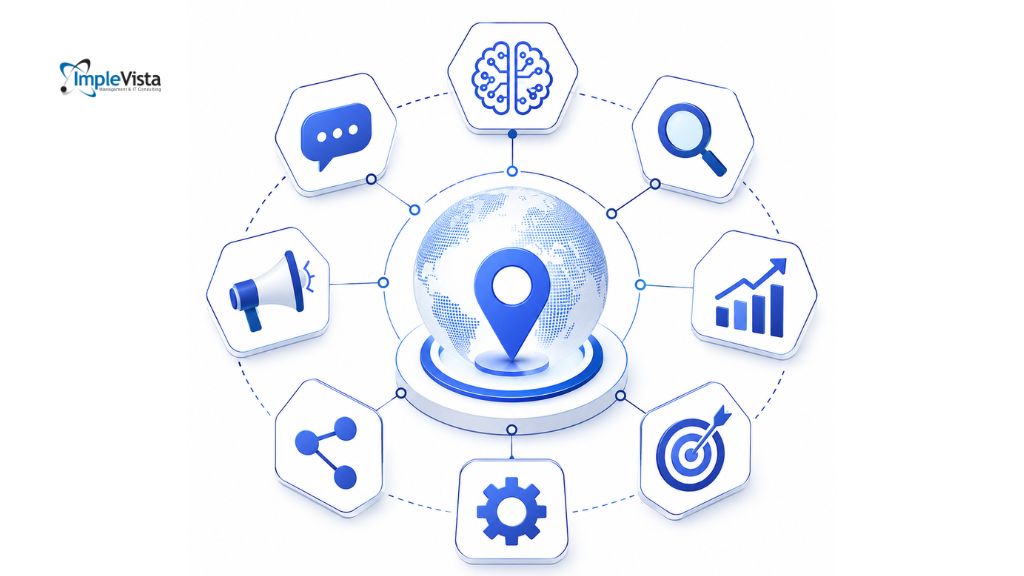
Understanding GEO in digital marketing means recognising that every piece of content you publish now has two audiences: human readers and AI engines. Great GEO-optimised content serves both simultaneously.
Here is a practical framework for integrating GEO into your digital marketing strategy:
- Audit your existing content: Identify pages that currently generate AI Overview citations. Use Google Search Console and manual AI query testing. Find gaps where competitors are being cited, and you are not.
- Restructure for extractability: Rewrite key pages with clear entity definitions, FAQ sections, structured data, and factual claims supported by evidence.
- Build topical authority: Publish comprehensive, in-depth content clusters around your core topics. AI engines favour brands that demonstrate genuine depth of expertise, not just breadth.
- Diversify your digital footprint: Ensure your brand is discussed positively in third-party sources — reviews, forums, industry publications, and social media.
- Align technical SEO with GEO: Schema markup, fast loading, mobile-first design, and clear site architecture serve both disciplines.
- Measure what matters: Track AI citations, branded search trends, and conversion quality — not just traffic volume.
- Iterate continuously: Generative engines update their retrieval and synthesis behaviours frequently. GEO is not a one-time optimisation — it is an ongoing practice.
At Implevista Digital, we have woven GEO (Generative Engine Optimization) principles into every element of our digital marketing service offering — from content strategy and technical SEO to business analytics and brand building. Our team has been tracking the AI search revolution since its earliest signals, and we bring that expertise directly to our clients.
7. Frequently Asked Questions: GEO (Generative Engine Optimization)
- What is Generative Engine Optimization (GEO)?
Generative Engine Optimization is the practice of improving content and digital presence so a brand’s information can be discovered, understood, and potentially referenced by AI-powered search and answer systems such as ChatGPT, Google AI Overviews, and Perplexity AI. GEO complements traditional SEO rather than replacing it.
- What is the difference between GEO and SEO?
SEO focuses on improving a website’s visibility in traditional search results. GEO focuses on visibility within AI-generated responses and search experiences. Both benefit from useful content, clear site structure, and strong technical foundations — Google’s own May 2026 guidance treats optimizing for its generative AI features as an extension of SEO rather than a separate discipline.
- How can I optimize my website for AI search?
Start with established SEO practices: make your website crawlable, publish useful and original content, answer relevant customer questions clearly, maintain accurate and consistent business information, and organize related content with meaningful internal links. There’s no confirmed separate playbook that substitutes for these fundamentals.
- Does schema markup guarantee AI search visibility?
No. Structured data helps search engines understand page content and can support eligible search features, but it does not guarantee a page will appear in AI-generated answers. Google’s own documentation confirms there’s no special schema requirement for AI Overviews or AI Mode. Use markup to accurately describe your content, not as a shortcut to a citation.
- How can businesses measure GEO performance?
Monitor your visibility in AI-generated responses through regular manual query testing, record brand mentions and citations over time, and review referral traffic and conversions from identifiable AI platforms (ChatGPT referral links, for example, carry a utm_source=chatgpt.com parameter). Google Search Console now also provides a dedicated Generative AI performance report covering AI Overviews, AI Mode, and Discover, rolled out to all sites worldwide as of August 31, 2026.
- Can small businesses benefit from GEO?
Yes. Small businesses can improve their chances of being discovered by creating useful, specific content that addresses their customers’ actual questions. Strong SEO fundamentals and clear, consistent business information are a practical starting point, though AI visibility can’t be guaranteed for any business regardless of size.
Conclusion: GEO (Generative Engine Optimization) Is the Future of Search, and That Future Is Now
Generative Engine Optimization is not a trend to monitor from the sidelines. It is a fundamental shift in how people find information, discover brands, and make decisions online. The businesses that act now — building authority, structuring content for AI extractability, and diversifying their digital presence — will be the ones that appear in the AI answers their customers are already reading.
The businesses that wait will find themselves invisible, not in a ranked list, but in the very source of truth that millions of users consult every day.
The core message is simple: SEO gets your content indexed. GEO (Generative Engine Optimization) gets it trusted, cited, and quoted. In 2026 and beyond, you need both.
At Implevista Digital, we are committed to helping businesses across Bangladesh and beyond navigate this new era. From our comprehensive digital marketing services at digital.implevista.com to our in-depth technology insights at blog.implevista.com and our enterprise software solutions at implevista.com, we build the full-stack digital capability that modern businesses need to thrive.
Whether you are a startup looking to establish AI-era visibility or an established brand ready to future-proof your search strategy, the right time to start is now.
Is Your Business Ready for AI Search?
Your business may already have a strong website and an established SEO strategy, but there could still be real gaps in how your content is discovered across AI-powered search experiences.
Implevista Digital’s Free Digital Growth Audit helps identify opportunities across SEO, GEO/AEO, Google Ads, Meta Ads, tracking, conversion rate optimization, and competitor gaps—so you understand exactly where your digital presence is strong and where the openings are.
Prefer to explore first? Read more insights on the blog or see how we’ve applied these principles in our case studies.