
Picture two business owners in Dhaka. One runs a diagnostic clinic; the other sells women’s fashion online. Each has BDT 50,000 to spend on ads this month. The clinic owner picks Facebook, gets flooded with Messenger inquiries, and books a handful of appointments. The fashion seller picks Google, pays for clicks from people searching for sarees, and wonders why the cart stays empty.
Next month, they swap channels, and the results flip.
Neither of them was unlucky. They matched the wrong platform to the wrong kind of customer. That is the heart of the Google Ads vs. Facebook Ads in Bangladesh debate: the two platforms are not rivals so much as tools built for different jobs. One catches people who are already looking. The other introduces your business to people who weren’t.
In this guide, we break down Google Ads vs Facebook Ads cost in Bangladesh, compare lead quality and conversion rates, work through a simple ROI example in taka, and show you how to choose (or combine) the right paid advertising channels for your business.
Quick Answer: Which Should You Choose?
If you want the short version, here it is.
- Choose Google Ads when customers already search for what you sell: clinics, lawyers, repair services, coaching centers, B2B suppliers, travel agencies, and high-ticket products.
- Choose Facebook Ads when your product is visual, impulse-driven, or new to the market: fashion, food, beauty, events, home décor, and brand launches.
- Use both when you have the budget. Facebook builds demand and retargets visitors; Google captures the demand when people are ready to buy.
Key takeaways:
- Facebook usually wins on cost per click and cost per lead.
- Google usually wins on lead quality and cost per sale.
- Your real ROI depends on your landing page, your follow-up speed, and your tracking, not just the platform.
- Test both with small budgets for 6 to 8 weeks, then move money toward what actually produces customers.
Google Ads vs. Facebook Ads in Bangladesh: How the Platforms Differ
Before comparing numbers, it helps to understand how each platform finds your customer.
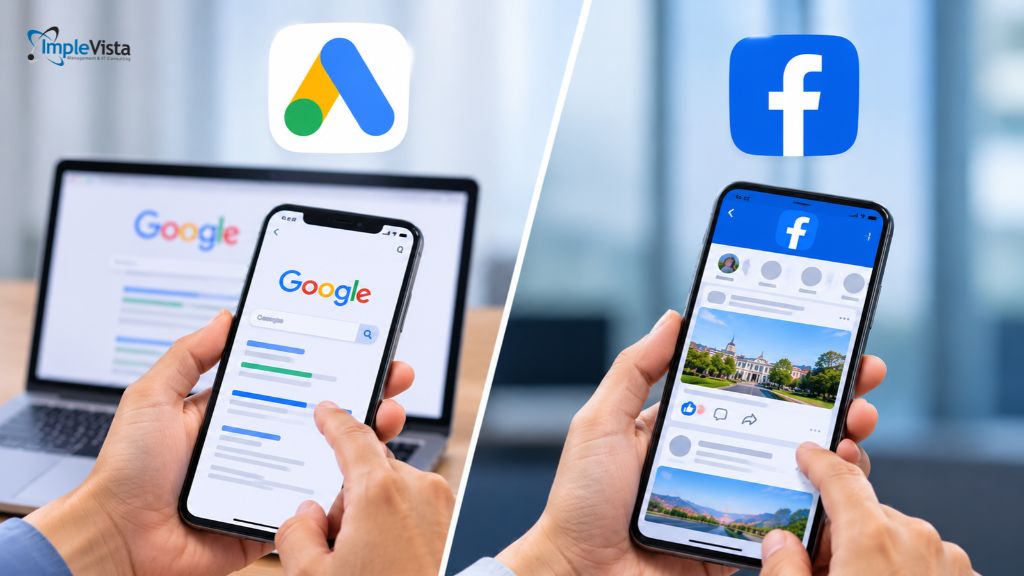
Google Ads works on intent. Someone types “AC repair Mirpur” or “IELTS course in Dhaka” into Google. Your ad appears at that exact moment. The person wants a solution now, so a click often turns into a phone call within minutes.
Facebook Ads work on interruption and interest. Nobody searched for you. Your ad appears in a feed between family photos and cricket highlights, and it has to earn attention in about a second. The targeting is powerful (age, location, interests, behavior), but the mindset is relaxed, not urgent.
That single difference explains almost everything else in this article: why Facebook clicks are cheaper, why Google leads close more often, and why the smartest advertisers use both.
The Bangladeshi Audience Context
The audience on both platforms is big. DataReportal’s latest analysis counts about 95.3 million internet users in Bangladesh at the end of 2026, and NapoleonCat’s tracking puts Facebook’s audience in Bangladesh at roughly 75 million people as of August 2026, with the largest group aged 18 to 24 and men making up a majority. Treat these as estimates, since they come from Meta’s own audience tools, but they tell a clear story: Facebook offers enormous reach, especially among younger, mobile-first users.
Google, meanwhile, remains the first stop when a Bangladeshi customer is ready to compare, book, or buy. If your buyers are older, higher-income, or researching a bigger purchase, search often matters more than the feed.
Google Ads vs Facebook Ads Cost in Bangladesh
Cost is where most business owners start, so let’s tackle it honestly.
A quick note on the numbers: public, audited benchmarks for Bangladesh are scarce, and costs shift by industry, season, and competition. The ranges below are illustrative planning figures based on how the platforms typically behave in lower-cost, mobile-heavy markets. Use them to sanity-check a proposal, then replace them with your own account data after your first few weeks of testing.
How Each Platform Charges You
- Google Ads (Search) is mostly pay-per-click. You bid on keywords, and you pay when someone clicks your ad. Google explains the auction and bidding options in its Google Ads Help Center.
- Facebook and Instagram Ads can charge per click, per 1,000 impressions (CPM), or per result, depending on your campaign objective. Meta documents the options in its Business Help Center.
Because Facebook often bills by impressions, your cost per click can look very low while your cost per customer stays high. Always compare platforms by what you pay for a lead and a sale, not just a click.
Google Ads Cost Per Lead in Bangladesh
Search clicks cost more because competition for buying intent is fierce. In everyday service categories, a click might cost anywhere from BDT 15 to BDT 60. In crowded niches such as real estate, private universities, loans, and interior design, it can climb well above that as advertisers bid against each other.
Once you factor in a typical landing page conversion rate, a planning range for Google Ads cost per lead in Bangladesh is roughly BDT 300 to BDT 1,500, depending on your industry and how well your campaign is structured.
What pushes it up or down:
- Keyword choice: specific phrases (“pediatrician in Uttara”) cost less per lead than broad ones (“doctor”).
- Negative keywords: excluding irrelevant searches stops wasted clicks.
- Quality Score: Google rewards relevant ads and landing pages with lower prices.
- Landing page speed and clarity: slow, cluttered pages burn money.
Facebook Ads Cost Per Lead in Bangladesh
Facebook clicks are far cheaper. A typical click might cost BDT 4 to BDT 15, and with lead forms or Messenger campaigns, a planning range for Facebook Ads cost per lead in Bangladesh is roughly BDT 80 to BDT 500.
That looks like a bargain, and sometimes it is. But remember the catch: many of those leads come from people who tapped a form while scrolling. Some won’t answer the phone. Some forgot they filled it out. The cheap lead is not always the cheap customer.
For context, global benchmarks tell the same story in higher-priced markets. Industry roundups regularly show Facebook clicks costing a fraction of Google Search clicks, while Facebook’s cost per lead sits well below the cost per customer you eventually pay.
Side-by-Side Cost Snapshot
| Metric | Google Ads (Search) | Facebook / Instagram Ads |
| Typical cost per click | BDT 15–60 (higher in competitive niches) | BDT 4–15 |
| Typical cost per lead | BDT 300–1,500 | BDT 80–500 |
| Lead intent | High: searching now | Low to medium: discovered while scrolling |
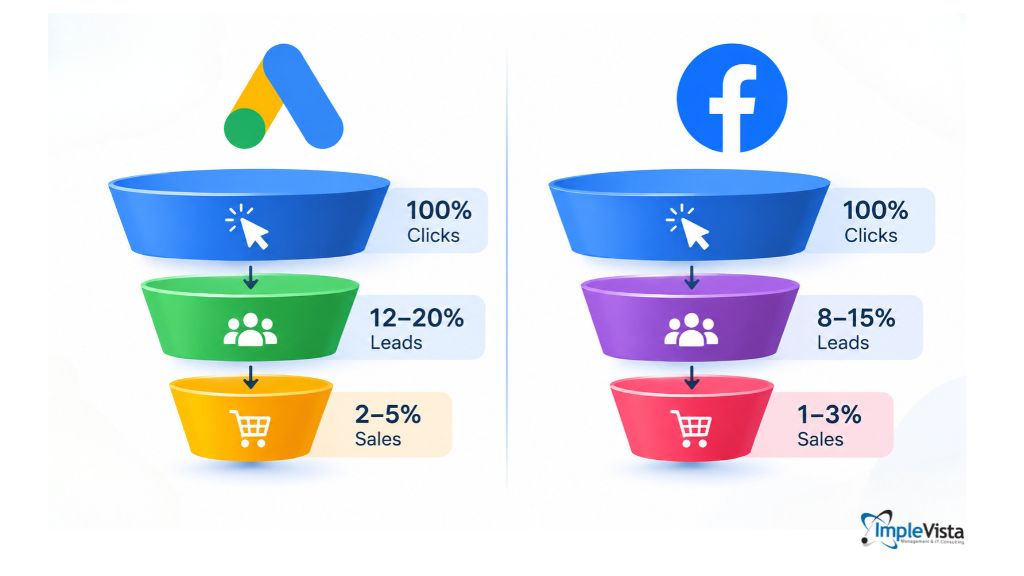
| Typical lead-to-sale rate | Often 15–30% | Often 5–15% |
| Best budget start | BDT 15,000–30,000 per month | BDT 8,000–20,000 per month |
These are planning estimates, not guarantees. Your market, offer, and follow-up process will move them.
If you’re still working out how much to set aside overall, our guide to digital marketing budgets in Bangladesh walks through realistic spending levels by business size.
Google Ads vs Facebook Ads for Lead Generation
The question behind Google Ads vs Facebook Ads for lead generation isn’t “which gets more leads?” It’s “which gets leads I can actually close?”
Facebook is the volume engine. Instant forms, Messenger chats, and WhatsApp click-to-chat ads make it very easy for people to raise a hand. If you sell something with a low price or an emotional pull, such as a salon package, a cooking class, or a weekend getaway, this volume can be a real asset.
Google is the quality filter. A person who typed a specific problem into a search bar has already done half your qualifying. You’ll usually get fewer leads, but a higher share of them are ready to talk price and timing.
Here’s a useful rule of thumb:
- High-ticket or urgent service? Lead with Google Ads.
- Low-ticket, visual, or impulse product? Lead with Facebook Ads.
- Long consideration cycle? Use Facebook to stay in front of people and Google to catch them when they finally search.
Speed of follow-up matters on both platforms. A lead contacted within minutes is far more likely to convert than one who hears back the next afternoon. If your team can’t reply fast, a cheaper lead won’t save you.
Google Ads vs Facebook Ads Conversion Rate: Why Clicks Aren’t Equal
People often compare Google Ads vs Facebook Ads conversion rate and get confused, because the two numbers measure different mindsets.
- On Google Search, a visitor is typically problem-aware and action-ready, so landing page conversion rates tend to be higher.
- On Facebook, a visitor is curious but distracted, so conversion rates tend to be lower, though the click was cheaper.
This is why a 2% conversion rate on Facebook and a 6% conversion rate on Google aren’t a sign that Facebook is “broken.” They’re a sign that the two platforms catch different moments.
Three things lift conversion rates on either platform:
- A message-matched landing page. If the ad says “Free eye checkup in Dhanmondi,” the page should say exactly that, not show a generic homepage.
- Mobile speed. Most Bangladeshi visitors arrive on a phone, often on a mobile connection. A slow page quietly kills campaigns. These user-friendly website design tips are a good starting checklist, and this piece on UI/UX design that drives higher conversions goes deeper.
- A simple next step. One clear button, one short form, or one WhatsApp link beats a menu of options.
Which Is Better, Google Ads or Facebook Ads for Sales?
This is the question we hear most, and the honest answer is: it depends on what “sales” means for your business.
For direct, trackable sales, Google often has the edge. When someone searches “buy running shoes Dhaka” or “book Cox’s Bazar hotel,” they’re already in buying mode. Shopping ads and search ads meet them at the finish line.
For discovery-led sales, Facebook often wins. Nobody wakes up searching for a product they’ve never heard of. A strong video or carousel on Facebook and Instagram creates the desire first. This is why new fashion labels, food brands, and gadgets often grow faster on social.
For repeat sales, Facebook’s retargeting is hard to beat. You can show ads to people who visited your site, added items to a cart, or messaged your page. A reminder at the right time often rescues sales you would otherwise lose.
So when someone asks, “Which is better, Google Ads or Facebook Ads for sales?” a more useful answer is
- Google closes demand that already exists.
- Facebook creates demand and brings it back later.
If you run an online store, it’s worth making sure your customer data and tracking are clean before scaling spend. Our post on why accurate customer data matters for ecommerce growth explains why, and our e-commerce solutions page shows how we support online stores end to end.
Google Ads vs Facebook Ads ROI Comparison: A Worked Example
Numbers make this concrete. Let’s run a Google Ads vs Facebook Ads ROI comparison for a hypothetical Dhaka business that sells a product at an average order value of BDT 8,000. Each channel gets BDT 50,000.
Every figure below is an assumption chosen for illustration. Swap in your own.
Google Ads scenario
- Cost per click: BDT 35 → about 1,430 clicks
- Landing page conversion rate: 6% → about 86 leads
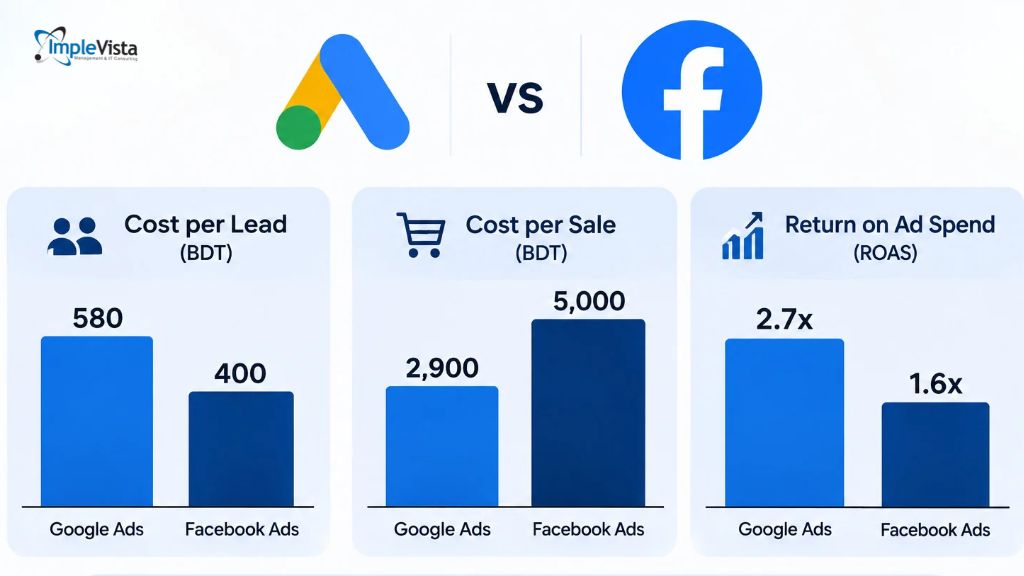
- Cost per lead: roughly BDT 580
- Lead-to-sale rate: 20% → about 17 sales
- Revenue: about BDT 137,000
- Cost per sale: about BDT 2,900 · Return on ad spend: about 2.7x
Facebook Ads scenario
- Cost per click: BDT 8 → about 6,250 clicks
- Landing page conversion rate: 2% → about 125 leads
- Cost per lead: BDT 400
- Lead-to-sale rate: 8% → about 10 sales
- Revenue: about BDT 80,000
- Cost per sale: about BDT 5,000 · Return on ad spend: about 1.6x
In this example, Facebook delivered more leads at a lower cost per lead, but Google delivered more sales at a lower cost per sale. That pattern is common for considered purchases.
Now change the scenario. If the product is a BDT 800 impulse item with strong visuals, Facebook’s volume and low click price could easily win. The ROI math flips with the product.
The formula to keep handy:
ROI = (Revenue – Ad Spend) ÷ Ad Spend × 100
And don’t forget lifetime value. A customer who buys three times a year is worth far more than the first order suggests, which can justify a higher cost per acquisition on either platform.
Google Ads vs Facebook Ads for Business in Bangladesh: An Industry Guide
Here’s how Google Ads vs Facebook Ads for business in Bangladesh tends to play out across common sectors.
- Clinics and diagnostic centers: Google Ads first. Patients search when they need care. Add Facebook for health-awareness campaigns.
- Real estate: Both. Google captures active buyers; Facebook showcases projects and retargets visitors over a long decision cycle.
- Online fashion and lifestyle: Facebook and Instagram first, then Google Shopping and retargeting as demand grows.
- Restaurants and cafés: Facebook and Instagram for offers and food photography, plus Google Business Profile for map searches.
- Education and coaching centers: Google Ads during admission season, Facebook for reaching students and parents.
- B2B services and software: Google Ads and LinkedIn, with Facebook mainly for retargeting.
- Travel agencies: Google Ads for ready-to-book searches (“Cox’s Bazar tour package”), Facebook for seasonal packages and inspiration. Travel businesses that also want to streamline bookings and follow-up can look at IV Trip travel agency software, which includes marketing automation alongside booking and accounting tools.
For a deeper look at how organic search fits alongside both ad platforms, read our comparison of SEO vs Google Ads in Bangladesh.
Paid Advertising Channels for Businesses in Bangladesh: Building a Smart Mix
Most growing businesses end up using paid advertising channels together rather than picking a winner. A practical way to structure a mixed budget:
- Start with the channel that matches your customer’s mindset. Searching customers → Google. Browsing customers → Facebook.
- Add retargeting early. Even a small Facebook retargeting budget can lift results from your Google traffic.
- Use Google data to shape Facebook creative. The search terms that convert tell you what language your customers use.
- Use Facebook data to find new Google keywords. Questions and comments reveal what people actually want to know.
A simple starting split for a new advertiser with a limited budget might be 60% on the channel that matches current demand and 40% on the other for testing. Adjust every two to four weeks based on cost per sale, not cost per click.
If you’d rather hand the setup to specialists, our PPC advertising service and social media marketing service pages explain how campaigns are built and managed. On our own site, we’ve shared how a client saw cost per click fall by 45% while conversion rates rose 2.3x in Google Ads campaigns, a good reminder that structure and optimization matter as much as budget.
Seven Mistakes That Waste Ad Budgets in Bangladesh
- Judging by clicks or likes. Clicks are not customers. Track leads and sales.
- Sending ads to the homepage. Use a dedicated page that matches the ad.
- Boosting posts instead of building campaigns. Boosts often miss the right audience and objective.
- Skipping conversion tracking. Without it, every decision is a guess. Our web analytics services can help set up reliable measurement.
- Slow follow-up. A cheap lead that waits a day is an expensive lead.
- Ignoring billing details. Check your billing currency, card requirements, and any local taxes before you launch so surprises don’t eat into your budget.
- Quitting too early. Both platforms need a learning period of a couple of weeks before you can judge costs fairly.
A Simple 30-60-90 Day Plan
- Days 1–30: Set up and learn. Install conversion tracking, build one focused landing page, and launch one small campaign on each platform.
- Days 31–60: Compare and trim. Look at cost per lead and cost per sale. Pause weak ad sets and keywords. Add retargeting.
- Days 61–90: Scale what works. Increase budget gradually (about 20% at a time) on winning campaigns, and refresh creative to avoid fatigue.
Conclusion
The real lesson of Google Ads vs. Facebook Ads in Bangladesh is that each platform answers a different question. Google asks, “What are you looking for right now?” Facebook asks, “What might you love that you haven’t discovered yet?”
Facebook usually gives you cheaper clicks and cheaper leads. Google usually gives you warmer leads and a lower cost per sale on considered purchases. Your product, price, and sales process decide which one pays off, and in many cases, the answer is a thoughtful mix.
The best next step is small and practical: pick one clear goal for the next 60 days, set up proper tracking, and test both platforms with modest budgets before you scale.
Ready to Find Your Winning Channel?
Implevista Digital’s team can audit your current ads, set up tracking, and build campaigns tuned to your goals.
- Talk to our team: book a free consultation.
- Explore our PPC advertising service: see how we manage Google Ads.
- Read next: SEO vs Google Ads in Bangladesh: Learn how organic search fits in.
- Subscribe to the Implevista blog: get practical growth and technology insights.
Frequently Asked Questions: Google Ads vs. Facebook Ads in Bangladesh
- Which is better in Bangladesh, Google Ads or Facebook Ads?
Neither wins every time. Google Ads is better when customers already search for your service, while Facebook Ads is better for visual products and building awareness. Most businesses get the best results by combining them.
- How much does Google Ads cost in Bangladesh?
There is no fixed price. Cost per click varies by keyword and competition, and a common planning range is roughly BDT 15 to BDT 60, with higher costs in competitive niches. Start with a monthly budget you can sustain for at least two months.
- How much do Facebook Ads cost in Bangladesh?
Facebook clicks are generally cheaper than Google clicks, often in the BDT 4 to BDT 15 range, and you can start with a small daily budget. Final costs depend on your audience, creative quality, and campaign objective.
- What is the average Google Ads cost per lead in Bangladesh?
A realistic planning range is about BDT 300 to BDT 1,500 per lead, depending on your industry, keywords, and landing page. Track your own numbers after a few weeks, since your results will differ.
- What is the average Facebook Ads cost per lead in Bangladesh?
Facebook leads often cost around BDT 80 to BDT 500, but lead quality varies. Always compare the cost per sale, not just the cost per lead.
- Which gives a better ROI comparison, Google Ads or Facebook Ads?
For high-intent, considered purchases, Google Ads often shows a better return. For impulse or visual products with strong creative, Facebook Ads can deliver a higher return. Calculate ROI using revenue minus ad spend, divided by ad spend.
- Which is better for lead generation?
Facebook usually produces more leads at a lower price, while Google produces leads that are more ready to buy. If your team can follow up quickly and screen leads well, Facebook can work very well. If you want fewer but warmer leads, choose Google.
- Is Google Ads or Facebook Ads better for a small business in Dhaka?
If customers search for what you sell, such as repairs, clinics, or tutoring, start with Google Ads. If your product is visual or new, start with Facebook and Instagram. Either way, begin with a small, trackable budget.
- Can I run Google Ads and Facebook Ads together?
Yes, and it often works best. Facebook builds awareness and retargets visitors, while Google captures people who search for you. Use consistent tracking so you can see which channel really drives sales.
- How long before I see results from paid ads?
Both platforms can send traffic within hours, but give campaigns two to four weeks to settle before judging costs. Real optimization comes from comparing results over six to eight weeks.