
The rise of advanced AI writing tools (like ChatGPT and GPT-4) has ignited a debate: by 2026, will AI content creators outpace human writers? This comprehensive guide explores the latest trends, data, and expert insights in the AI vs human writing battle. We compare speed, quality, creativity, SEO impact, and cost, while examining the future of content writing with AI in content marketing.
Throughout, we link to Implevista’s digital marketing and content services for relevant resources (e.g. Implevista’s Content Marketing services) that can help your strategy. By the end, you’ll understand who truly “wins” the content creation game – and how a hybrid content approach can leverage the strengths of both AI and human writers.

Speed & Efficiency: The AI Advantage
AI-powered writers excel at pumping out content rapidly. In an NP Digital study, AI chatbots like ChatGPT completed articles in a fraction of the time it took human writers. For example, crafting a blog post took an average of 16 minutes with AI versus 69 minutes for a human. This dramatic speed gap allows businesses to publish far more content in less time – a boon for volume-driven strategies.
In practice, AI article writers are used for quick turnarounds, draft generation, and producing multiple variations of copy. Marketers can feed AI tools topics or outlines and get a rough draft instantly. By automating routine writing tasks (like product descriptions, basic news reports, or social media posts), AI frees up time.
This advantage is especially valuable when speed is critical or budgets are tight. As Unified Infotech notes, AI content tools “optimize scalability and efficiency”, making them ideal for pumping out large volumes of SEO-focused content under tight deadlines.
However, raw speed comes at a cost. AI may write fast, but it often needs human oversight. Chatbots can misinterpret context, produce inaccuracies, or use awkward phrasing that requires editing. In our content recommendations (and Implevista’s Content Marketing approach), we suggest using AI to handle the backbone of content – outlines, data aggregation, and repetitive sections – then letting human writers refine the tone, verify facts, and add creativity.
For example, you might ask an AI to draft a blog outline or generate an FAQ section, then have your best writer polish it. This way, you harness AI’s speed without sacrificing quality.
Key Takeaways (Speed): AI writing tools dramatically cut production time (AI: ~16 min vs Human: ~69 min). This is great for bulk content or tight schedules. But AI alone often misses nuances – human editing is still needed to ensure accuracy and maintain brand voice. In short, AI wins on speed, but humans provide crucial quality control.
Traffic & Engagement: Human Content Wins
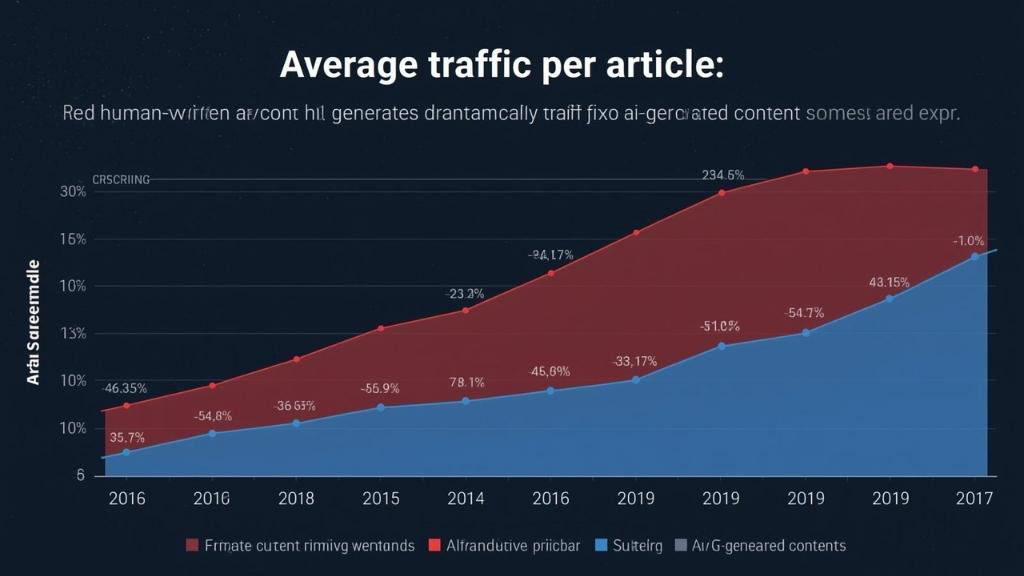
When it comes to performance and audience engagement, human-written content currently holds the upper hand. In the NP Digital study, content written by humans consistently attracted more readers than AI-generated pieces. By month 5, the human-written articles had 5.44× the traffic of the AI-written ones. In other words, even though humans took longer to write each article, their output drove far more site visits and engagement.
Why do human articles perform better? There are several reasons. First, human writers tailor content to audience needs and intent, whereas AI may produce generic or off-topic text without deep context. The NP Digital data showed human content’s traffic steadily climbed over five months, while the AI content floundered.
Furthermore, search algorithms currently seem to favor high-quality, in-depth content. A 2025 SEO study by Rankability found that 83% of top Google results were human-written, not AI-generated – indicating the algorithms reward authenticity and richness. Indeed, the Rankability team notes: “high-quality content written by a human performs better than LLM content”.
Unified Infotech also emphasizes this human edge. They report that humans infuse content with “imagination, emotion, and lived experiences” that AI cannot replicate. This makes human-written content “more engaging, original, and memorable,” leading to deeper user engagement and shares.
In practice, human articles often include personal anecdotes, creative storytelling, or expert analysis – elements that attract readers and keep them on the page longer. In contrast, AI-generated text can feel flat or repetitive, causing readers to skim or skip it. As Unified Infotech’s comparison highlights, AI content is prone to audience fatigue and oversaturation, whereas human content avoids redundancy with unique insights.
AI vs Human Writers (Traffic): The data is clear – human writers currently win on performance. Even though AI-generated articles can rank and attract some traffic, human-authored content tends to generate more clicks, longer engagement, and higher trust.
In content marketing terms, this means blog posts, guides, and articles written by people are more likely to attract organic traffic and build brand authority. For 2026, the wise strategy is to have humans produce core, high-value content that drives traffic, while using AI to support research and drafting.
Creativity, Context & Emotional Intelligence: The Human Edge
One of the biggest differentiators between AI and human writers is creativity and emotional nuance. Human authors bring personal voice, humor, empathy, and cultural insight that AI tools struggle to emulate. A 2025 University College Cork study of stylometry found that AI prose “continues to display a detectable stylistic fingerprint” – in other words, AI writing tends to follow uniform patterns in word choice and syntax, lacking the variety of human prose.
The researchers showed that even the latest AI models (GPT-3.5, GPT-4, etc.) produce text clusters that look “tightly grouped” and formulaic, whereas human writing shows far greater variation and creativity. As the lead researcher noted: “AI writing is often polished and coherent, but it tends to show more uniformity in word choice and rhythm. In contrast, human writing remains more varied and idiosyncratic”.
This stylistic difference translates into emotional impact. Human writers draw on real experiences and emotions to connect with readers. For instance, human authors can craft powerful narratives that inspire fear, joy, or compassion. According to Gallup, 70% of consumer decisions are driven by emotion, so storytelling and tone matter a lot in marketing.
Human writers excel at this: they know how to frame a topic in an emotional context or inject subtle humor or urgency. AI, meanwhile, can mimic tone but often misses the mark on genuine feeling. The NP Digital analysis notes that AI-generated posts “fell short” on context and empathy, whereas human writers naturally embed insights and emotional cues. This means human-written content can engage readers on a deeper level and build trust – something purely AI-driven text struggles to achieve on its own.
Unified Infotech explicitly points out that AI cannot replicate authentic creativity. They emphasize that human writers bring imagination and “lived experiences” that make content engaging. This includes understanding nuanced brand voice and writing with intention.
For example, a skilled copywriter will know how to adapt messaging for a luxury audience versus a tech-savvy crowd – a subtlety that AI often misses. Human writers also excel in complex, narrative-driven formats (long-form guides, thought leadership, personal essays) where insight and interpretation are crucial.
AI vs Human Writers (Quality): In summary, human writers currently produce higher-quality, more original content. AI can generate facts and structure, but it lacks the context-awareness and emotional intelligence of people. For brands and marketers, this means relying on human creativity for authoritative blog posts, brand storytelling, and any content that requires nuance.
AI can assist with drafting or data, but the final polish and strategic voice should come from humans. As Unified Infotech and stylometry studies confirm, by 2026 humans will still hold an edge in creativity, context, and emotional resonance.
Hybrid Content Strategy: Humans + AI Working Together
The real “winner” may not be AI versus humans, but rather AI plus human in combination. Most experts agree that the future of content is hybrid. AI offers speed and data processing, while humans supply creativity and oversight. Embracing a hybrid model lets you get the best of both worlds.
In fact, by 2026 we expect AI to be an “indispensable part of any successful content team” – not a replacement for writers. AI tools can handle brainstorming, topic research, and initial drafting, freeing human writers to focus on storytelling and fine-tuning.
Stanford’s HAI research also suggests a shift toward evaluation over hype in 2026: companies will learn from early AI projects and figure out where AI truly adds value. In content creation, this means using AI strategically. For example, use AI for:
- Idea generation and research: Ask AI to suggest blog topics or summarize industry reports. It’s great at scanning data and surfacing trends.
- First drafts and outlines: Generate a content outline or introduction with AI. Then a human writer expands and refines it. This cuts initial writing time.
- SEO optimization: AI can help incorporate keywords and check readability. (Just be careful – Google’s guidelines stress content quality, not keyword stuffing.)
- Data analysis: Let AI analyze audience engagement metrics or market data, then a human crafts narratives around it.
Unified Infotech highlights that a hybrid approach “optimizes both quality and efficiency”. AI brings scalability, and humans add nuance. For example, a common workflow might be: use an AI article writer to draft a product description or listicle, then have your best writer rewrite it to match brand tone and add unique insights.
This can save time while ensuring originality. According to Unified Infotech, blending AI with human editing yields “something truly unique,” combining structure and facts from AI with personal voice and creativity from writers. Implevista itself adopts this philosophy in content marketing services.
Our team might use AI-driven keyword tools to identify trending topics (giving us dozens of ideas instantly), but then our content strategists craft in-depth articles around those topics. As Implevista’s digital marketing strategy guide notes, our approach “integrates your content and SEO efforts” for maximum impact – a process where AI helps with the data and humans tell the compelling story.
By 2026, businesses that harness hybrid content will likely see the best ROI. You get the volume advantage of AI plus the engagement edge of human-written content.
Key Hybrid Insights: Use AI as a tool, not a substitute. For routine tasks (research, outlines, drafts), AI shines. For strategic, high-stakes content (thought leadership, branding, high-traffic pages), humans should lead. This combined approach not only improves quality but also aligns with Google’s evolving SEO algorithms, which reward well-researched, high-quality content. In 2026, the content teams that win will be those where writers use AI tools to supercharge creativity, not replace it.

SEO & Content Marketing in 2026: AI’s Role
From an SEO perspective, content must remain authoritative and useful – factors where human writers currently score higher. While Google has clarified it won’t inherently penalize AI content, its algorithms clearly reward quality. The Rankability study saw that most top-ranked pages used human-crafted content. This is likely because human content often better answers user queries and demonstrates expertise (E-E-A-T) – crucial signals for Google’s Search Generative Experience.
Additionally, modern search now features AI Overviews and answer boxes. To succeed, content needs clear structure and direct answers. Implevista’s own blog on SEO recommends answering questions concisely, using headings and bullet lists – practices that help both human readers and AI algorithms.
Whether written by humans or AI, content must follow these best practices to rank. In fact, Implevista’s digital marketing team already uses AI for SEO and user insights, showing that AI tools are valuable for optimizing content strategy. But the writing itself must remain high-quality.
In content marketing terms, this means AI tools can help identify keywords, draft meta tags, or suggest related topics. Yet the actual blog posts, product pages, and articles should leverage human expertise. For example, Implevista’s Content Marketing service emphasizes “high-quality content” that tells a brand’s story and provides value.
Good content engages readers and earns backlinks – outcomes still more common with human-authored material. By 2026, expect AI to be deeply integrated in the content workflow (for analytics, personalization, etc.), but Google will favor whichever content truly satisfies users.
Who Wins in SEO? Right now, humans hold a slight edge because they naturally create E-E-A-T-rich content. However, as AI gets smarter, the gap may narrow. Ultimately, search engines like Google care about user satisfaction. Whether content is AI-generated or human-written, it must be clear, well-structured, and informative.
We recommend a mixed approach: use AI for SEO research and optimization tasks, but have humans craft the actual user-facing copy. This aligns with Implevista’s strategy: we conduct rigorous keyword research (using AI-powered tools) and then organically incorporate terms into our storytelling. This way, we leverage AI without sacrificing authenticity.
The Bottom Line: Who’s Better?
By 2026, AI writers will be far more capable than today, but they won’t fully replace human writers. Humans and AI each have strengths: AI is unbeatable on speed and scaling up content production, while humans excel in creativity, accuracy, and emotional resonance.
Current data and expert analysis show human-written content still outperforms AI-generated content in traffic, engagement, and trust. A University of Chicago study confirms that AI “continues to follow a narrow and uniform pattern” unlike human prose, meaning the human touch remains unique.
However, AI writing tools are already indispensable for content teams. Rather than asking “who’s better,” the smart question is “how can we use both?” Our recommendation is hybrid content: let AI assist with research, ideas, and drafts, and let human writers refine and add depth.
In practical terms, hire skilled writers for cornerstone content and oversight, and use AI tools (some of which even Implevista offers) for everything else. This model boosts efficiency without losing quality. By 2026, expect most content strategies to follow this blend.
Human writers still lead in quality and engagement, but AI powers speed and insight. The “winner” in 2026 will be organizations that combine them. As Implevista notes, “content marketing is about telling your brand’s story, providing value, and building a loyal audience” – goals best achieved when AI and humans collaborate. Whether you need faster blog production or emotional storytelling, Implevista’s digital marketing experts can help you harness AI and human creativity together for maximum impact.
👉 Ready to supercharge your content strategy? Contact Implevista Digital for expert help. Explore our Content Marketing services or subscribe to the Implevista Digital Marketing Blog for the latest insights. Let’s work together to create high-quality content that ranks and resonates!

FAQ About AI vs Human Writers
Q: Can AI replace human writers by 2026?
A: AI will continue improving, but it won’t fully replace skilled human writers. AI can automate routine writing tasks and boost efficiency, but humans provide creativity, context, and fact-checking. For now, combining AI tools with human editing yields the best results.
Q: How does content quality compare between AI and human writers?
A: Studies show human-written content generally scores higher on quality and engagement. For example, NP Digital found human articles received much more traffic than AI drafts. Human writers infuse emotion and expertise that AI lacks, making their content more authentic and valuable to readers.
Q: Is AI content better for SEO?
A: Not inherently. Google’s algorithms favor well-written, authoritative content, regardless of origin. If AI content is high-quality and user-focused, it can rank. But poorly written AI content can underperform or even be penalized as low-quality. The focus should be on usefulness and expertise.
Q: What are the strengths of AI article writers?
A: AI shines in speed and scale. It can generate drafts, headlines, summaries, and ideas almost instantly. It’s useful for keyword insertion, brainstorming topics, or producing multiple content variations rapidly. This makes AI ideal for content ideation and rough drafts.
Q: What advantages do human writers have over AI?
A: Humans bring creativity, nuance, and empathy. They can adapt tone to a brand, craft compelling stories, and understand complex topics deeply. Human writers fact-check, cite sources, and tailor content for specific audiences – tasks where AI often falls short.
Q: What is hybrid content creation?
A: A hybrid strategy uses both AI and human writers together. For example, you might use AI to draft an outline or gather data, then let human writers expand on ideas and refine the tone. This approach maximizes efficiency (AI) without sacrificing quality (human). It’s increasingly common in content marketing.
Q: Will search engines penalize AI-generated content?
A: Not automatically. Google’s policy isn’t against AI content per se, but against spammy or manipulative content. Recent studies found top-ranked pages tend to be human-authored, suggesting Google values depth and originality. The key is to ensure any AI-written content meets quality guidelines.
Q: How can I use AI tools effectively in content marketing?
A: Use AI for tasks like keyword research, topic generation, or drafting simple copy. Always review and edit the AI output to add your brand voice and accuracy. For instance, use AI to list blog ideas or create a first draft, then refine it manually. This ensures speed without compromising uniqueness.
Q: What does the future of content writing look like with AI?
A: By 2026, AI will be an integral assistant for writers. Expect AI to handle more research, personalization, and initial drafting, while human writers focus on strategic, high-impact content. Content teams will work with AI as a “creative co-pilot,” using it to inform decisions and generate ideas, but humans will remain essential for final quality and connection with readers.
Q: Who “wins” the AI vs human writers debate?
A: It’s not about one winning. AI and human writers each have distinct strengths. Human writers usually produce higher-performing content, especially for complex topics, but AI dramatically improves efficiency. The “winner” is a well-planned content strategy that leverages both – using AI for speed and data, and human writers for quality and insight.